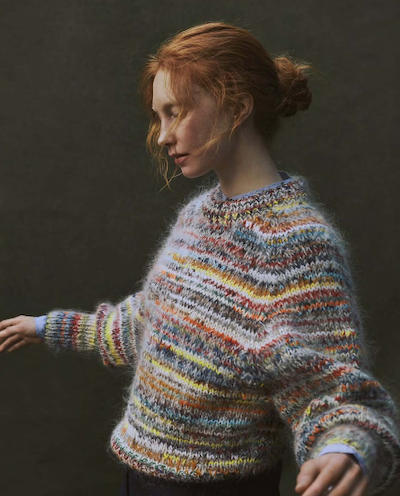
Inside hand-knit production.
From tech pack to swing tag, every stage of a KOCO order, done by hand with zero electricity.
A KOCO order moves through five hand-only stages: tech pack scoping, written pattern creation, an individual tension swatch, hand-knitting by one named artisan, and hand-finishing with a swing tag. No machine touches the garment at any stage, and the same artisan knits it from first stitch to last.
How hand-knitted production works, stage by stage
Production begins when a brand sends a tech pack or sketch. KOCO scopes it for stitch count, yarn yield and feasibility, then writes a separate written pattern for each size. Where an industry pattern runs to four or five pages with abbreviations, a KOCO pattern runs to fifty pages or more for a single size, with no abbreviations, so a knitter can follow it line by line.
Before any garment is knitted, the assigned artisan knits an individual tension swatch to confirm gauge against the written pattern. The garment is then knitted by that one artisan, on bamboo and timber needles, from first stitch to last. Joining, finishing, blocking and washing are all done by hand. There is no linking machine, no steam press, no electric blocking board, no washing machine.
Lead times reflect the method, not a machine schedule. A hand-knit garment takes longer than a machine-knitted one because every stitch is placed by a person. We quote a realistic lead time at scoping and hold to it, because the constraint is artisan hours, not machine capacity.
Each stage, and what is used to do it.
| Stage | What is used | Who does it |
|---|---|---|
| 1. Tech pack scoping | Tech pack or sketch, reviewed by hand | KOCO pattern team |
| 2. Pattern writing | Written pattern, 50+ pages per size, no abbreviations | KOCO pattern team |
| 3. Tension swatch | Bamboo or timber needles, yarn to spec | The assigned artisan |
| 4. Hand knitting | Bamboo and timber needles, zero electricity | One named artisan, first stitch to last |
| 5. Finishing and swing tag | Hand-joining, hand-blocking, hand-washing | The same artisan, then tagged with her name |
Plan to the method, not against it.
Because one artisan knits each garment from start to finish, consistency comes from the written pattern and the tension swatch, not from a machine setting. That is what lets a run of hundreds hold the same gauge as a single prototype.
If your timeline assumes machine throughput, it will not fit hand-knit production. Bring us in at the design stage and we will scope a realistic lead time against your collection calendar.
What sourcing directors ask us.
It depends on stitch complexity, garment type and order size. We quote a specific lead time at scoping once we have seen the tech pack. The constraint is artisan hours, so a complex cable garment in a run of 200 takes longer than a simple stockinette piece in a run of 20.
Yes. Send the sample or the tech pack. We write the pattern from it, knit a tension swatch, and produce a prototype for your sign-off before bulk knitting begins.
Each garment is knitted from first stitch to last by a single named artisan. In a run, the written pattern and tension swatch hold consistency across artisans, and each piece carries a swing tag naming who made it.
Send us your tech pack.
We will come back with feasibility, indicative costing and lead times for your hand-knit project.